A small company doesn’t need a robot fleet to test automation. It needs one repeatable task with a clear cost, cycle time, and handoff. The buying question is whether the full system can earn its place in one work area once you price the robot’s headline features alongside the rest of the cell.
- Price the robot cell, not the arm alone.
- Start with a task that repeats every shift.
- Keep a human fallback for work the system can’t handle.
Price the full work cell
A robot arm is one line on a quote.
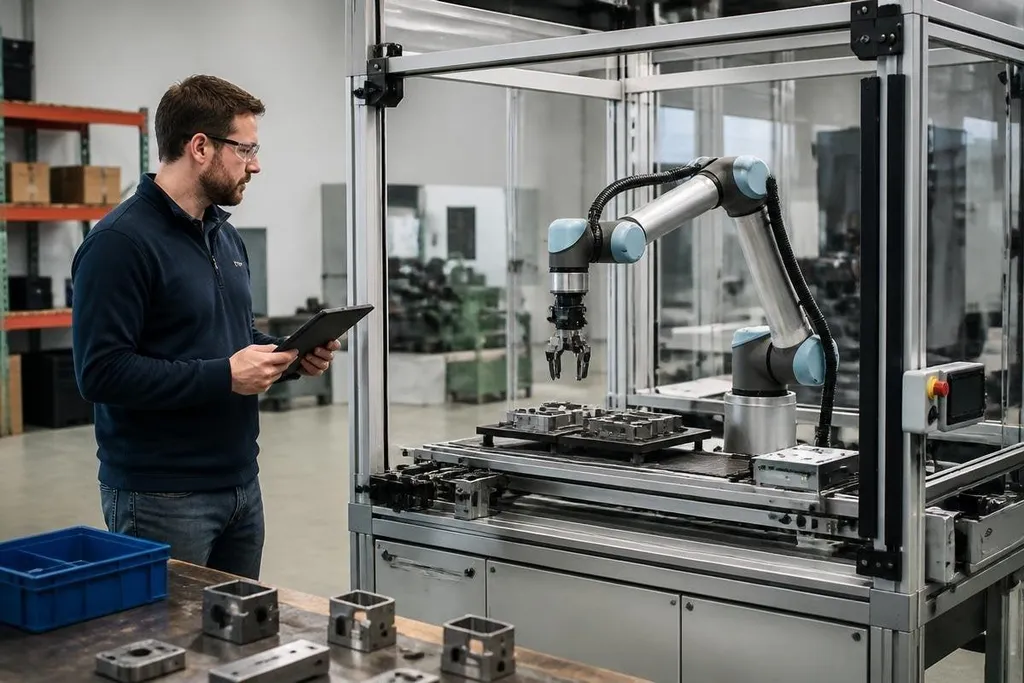
The working cell may also need a gripper, camera, controller, safety scanner, guarding, fixtures, software, installation, training, and service. Each item changes the amount of money tied up before the first part moves.
Ask the supplier for two totals: the purchase price and the cost to run the cell for one year. The second figure should cover power, planned service, replacement parts, software fees, and the labor needed to load materials or clear faults.
Cash flow matters as much as the total price. A lower purchase cost can still strain a small company if payment arrives before the cell produces saleable work. Leasing, rental, or a staged purchase may fit better, but compare the full payment schedule with the cost of keeping the task manual.
Pick the task before the robot
Start with work that has a fixed input, a clear output, and few changes between batches. Loading a machine, placing parts in a fixture, or moving sealed products may be easier to define than a job that needs constant visual judgment.
Write down the task’s current cycle time, error rate, shift pattern, and handoff points. Then record what the robot must lift, how far it must reach, and how the part arrives. These details decide the arm’s payload, reach, end effector, and sensor needs.
A short demonstration can hide the work around the robot. Someone may still need to feed parts, remove finished pieces, inspect results, or reset the cell after a stop. Count those steps before comparing a robot cycle with a person’s full task cycle.
A robot’s price leaves out the brackets, sensors, software links, and staff time needed to make it work with your line. Reports from Robot24 give you named machines and deployment details to compare with a supplier’s estimate before you check the integration risk.
Check the integration risk
The robot may be ready to move, while the production line is not ready to receive it. Confirm the connection to the machine controller, the available floor space, network access, electrical supply, guarding, and emergency-stop layout.
Safety work needs a named owner. That person should know who can enter the cell, how the robot stops, what happens after a power loss, and how staff restart production. A safety-rated scanner or stop circuit can affect both the design and the cost.
Training also needs a place in the plan. Staff should be able to load parts, change a fixture, read fault messages, and return the cell to a known state. If only one person can do those jobs, a sick day can stop the process.
The open question is often service. Ask how faults are handled outside local business hours, where spare parts ship from, and which repairs your staff can do. A small operation may accept a slower cycle if it can fix common stops without waiting for a specialist.
Use a short payback test
Estimate the yearly cost of the current task, including wages, overtime, scrap, rework, and missed production. Compare that figure with the robot cell’s yearly cost, then test the result against a lower production volume.
Payback based on full output can mislead. A cell that needs 95% utilization to cover its cost leaves little room for demand changes, setup time, or faults. Run the calculation at the work level you can support now, not the volume you hope to reach later.
I'd wait when the task changes often, the part supply is inconsistent, or the quoted system needs a large custom build before anyone can test it. In those cases, a better first purchase may be a fixture, conveyor, inspection camera, or process change.
Buying checklist
Use these questions before signing a purchase order:
- Name the task: What exact motion or handoff will the robot perform?
- Record the baseline: What are the current cycle time, scrap rate, and labor hours?
- Request the cell price: Which gripper, guarding, software, training, and service costs are included?
- Test the exception: What happens when a part is missing, damaged, or out of position?
- Assign ownership: Who can change the program, clear a stop, and approve a restart?
- Set a limit: At what yearly cost or downtime level will you stop the project?
Advanced robotics can fit a small company when the first job is narrow, repeatable, and tied to a real production cost. Start with that task, demand a full quote, and leave the larger rollout for after the cell earns its place.